Dianella
Dianella caerulea
Also known as: Flax Lily, Blue Flax Lily, Native Flax
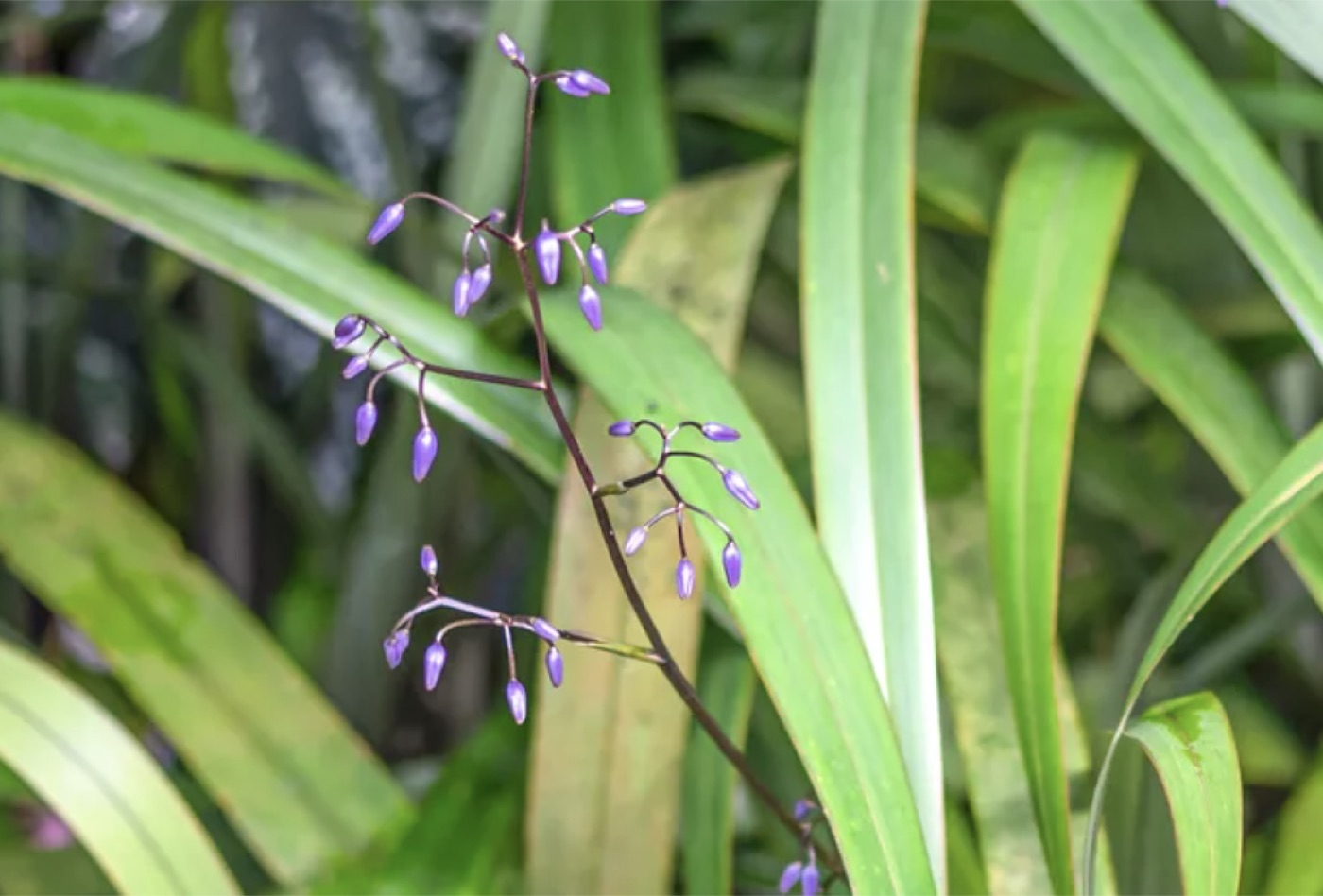
'Dianella' is a diminutive of Diana – the Roman goddess of the hunt and wild nature – perhaps evoking the plant's graceful, woodland character. The common name 'flax lily' refers to the flax-like fibrous leaves used by Aboriginal Australians to weave baskets, bags, and fishing nets. Dianella is a genus of grass-like, clumping perennials found throughout Australia in heathlands, forest understorey, coastal scrub, and dunes. This entry covers Dianella caerulea specifically. The plant has long, arching, strap-like leaves and produces delicate star-shaped blue or mauve flowers followed by striking, glossy blue-purple berries. The ripe berries and the nectar from the flowers are the edible parts; other parts of the plant are not eaten. Dianella is a large genus, and several other species grow in the same habitats – some edible, some toxic – so positive identification of D. caerulea is essential before eating (see Lookalikes).
When to Forage
Flowers in spring–summer; berries ripen in summer–autumn and persist on the plant for some time.
Cautions
Only the ripe berries are eaten. Unripe berries and other plant parts may cause gastrointestinal upset. Consumption of large quantities of berries has been associated with nausea and diarrhoea in some individuals – eat in moderation. Do not confuse with toxic lookalikes; be especially cautious as other species within the same genus are toxic (see below).
Nutrition
The blue berries contain anthocyanins and other flavonoid antioxidants responsible for their colour, as well as small amounts of sugars, vitamin C, and dietary fibre. Nutritionally modest – better considered a trail snack or flavour addition than a dietary staple.
How to Identify
- Clumping, grass-like plant with long, strap-like, tough leaves that are usually dark green and may have a rough or serrated edge.
- Flowers are small, six-petalled, blue, mauve, or white stars with yellow anthers; borne in loose, branching sprays on slender stems.
- Berries are brilliant, glossy blue, violet, or purple; rounded; 6–10 mm diameter; borne on thin arching stalks.
- The fibrous leaves are nearly impossible to tear cleanly and were prized by Aboriginal Australians as weaving material.
Lookalikes
Similar strappy, arching leaves and clumping habit, but the fruit is very different: Lomandra produces a small, round, hard capsule rather than Dianella's glossy fleshy berry. See the Lomandra entry.
A similar-looking strappy-leaved plant, but with noticeably smaller leaves. Toxic – causes a degenerative nerve condition in livestock and should not be eaten. Do not confuse with Dianella.
The genus is large and easily confused at a glance. Some species are considered toxic, such as D. tasmanica and D. intermedia. Others are considered edible, such as D. revoluta, D. longifolia, D. congesta, D. brevicaulis, D. pavopennacea, and D. bambusifolia. Always confirm you have D. caerulea (or another known-edible species) before eating the berries – when in doubt, leave it out.
White, bell-shaped flowers; all parts toxic. Very different flower form.
How to Forage
Pick only fully ripe, glossy blue-purple berries directly from the plant by hand. Avoid green or pinkish berries. Taste is mild and slightly sweet. Consume in small quantities. The fibrous leaves were traditionally soaked and split to extract the long, strong fibres used for weaving.
Recipe — Dianella Berry and Coconut Yoghurt Parfait
Ingredients: 1/2 cup ripe Dianella berries; 1 cup thick coconut yoghurt; 1 tbsp maple syrup or native honey alternative; 1/4 cup toasted oats or muesli; pinch of ground lemon myrtle (optional). Method: Gently rinse Dianella berries and pat dry. Layer coconut yoghurt in a bowl or glass. Top with berries and toasted oats. Drizzle maple syrup over, and dust with ground lemon myrtle if available. Serve immediately as a light breakfast or dessert.
Want more?
Join our newsletter for more recipes, foraging guides and upcoming events.