Comfrey
Symphytum officinale
Also known as: Comfrey, Common Comfrey, Knitbone, Bruisewort, Boneset
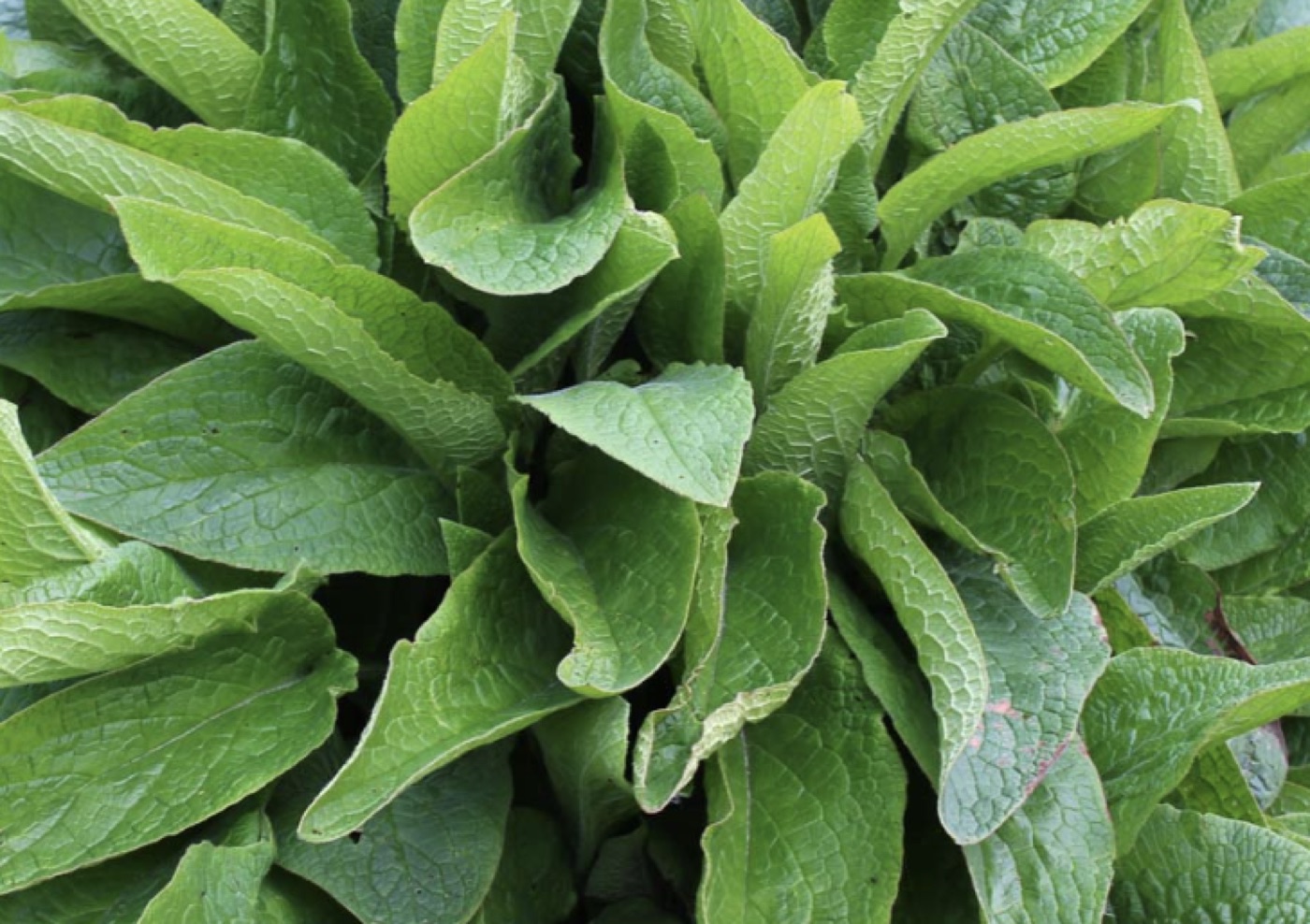
'Symphytum' comes from the Greek 'symphyo' (to make grow together), referring to its long history as a wound-healing and bone-knitting herb. 'Officinale' marks it as an official medicinal plant. The English names – knitbone, boneset, bruisewort – all reflect this same tradition of healing fractures and soft-tissue injuries. Comfrey has been cultivated for at least 2,000 years. It is a large, robust, deep-rooted perennial herb of the borage family (Boraginaceae), naturalised in moist, disturbed ground, creek banks, garden margins, and waste areas throughout south-eastern Australia. It forms impressive clumps of very large, rough, dark green leaves from a deep, black-skinned taproot, and bears clusters of nodding, tubular flowers in purple, pink, or white. It is one of the great traditional medicinal herbs of Western herbalism. Its edibility is nuanced – see cautions.
When to Forage
Leaves available spring through autumn; flowers in spring and early summer. Plant dies back in winter but returns strongly from the root.
Cautions
Comfrey contains pyrrolizidine alkaloids (PAs), which are hepatotoxic (damaging to the liver) with prolonged or high-dose internal consumption – for this reason, eating comfrey as a regular green vegetable is not recommended. The leaves are best considered a topical herb (used externally as a poultice) rather than an everyday food. If eaten at all, do so rarely, in small amounts, young leaves only, and always cooked. Avoid entirely if pregnant, breastfeeding, or with liver conditions, and not for children. External use on intact skin is considered safe.
Nutrition
Very high in allantoin (a cell-proliferating compound that promotes healing of skin, bone, and connective tissue – hence its wound-healing reputation), mucilaginous polysaccharides, rosmarinic acid (anti-inflammatory), tannins, calcium, potassium, and protein. The leaves also contain vitamin B12 – unusual for a plant. Despite its impressive nutritional profile, internal use should be strictly limited due to PA content.
How to Identify
- Very large plant – basal leaves can reach 60 cm long – with a rough, coarse texture due to dense, stiff hairs that can cause skin irritation in sensitive individuals.
- Leaves are broadly lance-shaped, dark green, with a prominent midrib and distinct 'decurrent' wings that run down the leaf stalk and continue along the stem – a useful identifying feature.
- Stems are upright, 50–120 cm tall, branching, also roughly hairy and winged.
- Flowers: tubular, drooping in curved clusters (scorpioid cymes), in shades of purple, mauve, pink, or white, opening sequentially.
- Root is very deep, black on the outside, white and mucilaginous on the inside. The plant regenerates from even small fragments of root.
Lookalikes
Both have large, soft, oval-ish leaves and produce tall flowering spikes with tubular flowers. Foxglove flowers are dramatically different – large, thimble-shaped, and spotted inside. Comfrey flowers are much smaller and clustered; comfrey leaves are coarser and run down the stem. Foxglove is seriously toxic. Always confirm species before handling.
Also in the borage family with similar bristly texture. Much smaller plant with star-shaped blue flowers (not tubular). Borage does not have the large decurrent leaf wings of comfrey.
How to Forage
Comfrey is better appreciated as a garden medicinal plant: fresh leaves are excellent as a poultice for bruises, sprains, and slow-healing wounds (apply externally only). It is also used as a high-nitrogen liquid fertiliser for gardens – steep leaves in water for 4–6 weeks to make a nutrient-rich plant feed.
Want more?
Join our newsletter for more recipes, foraging guides and upcoming events.