Borage
Borago officinalis
Also known as: Borage, Star Flower, Bee Bread, Tale Wart
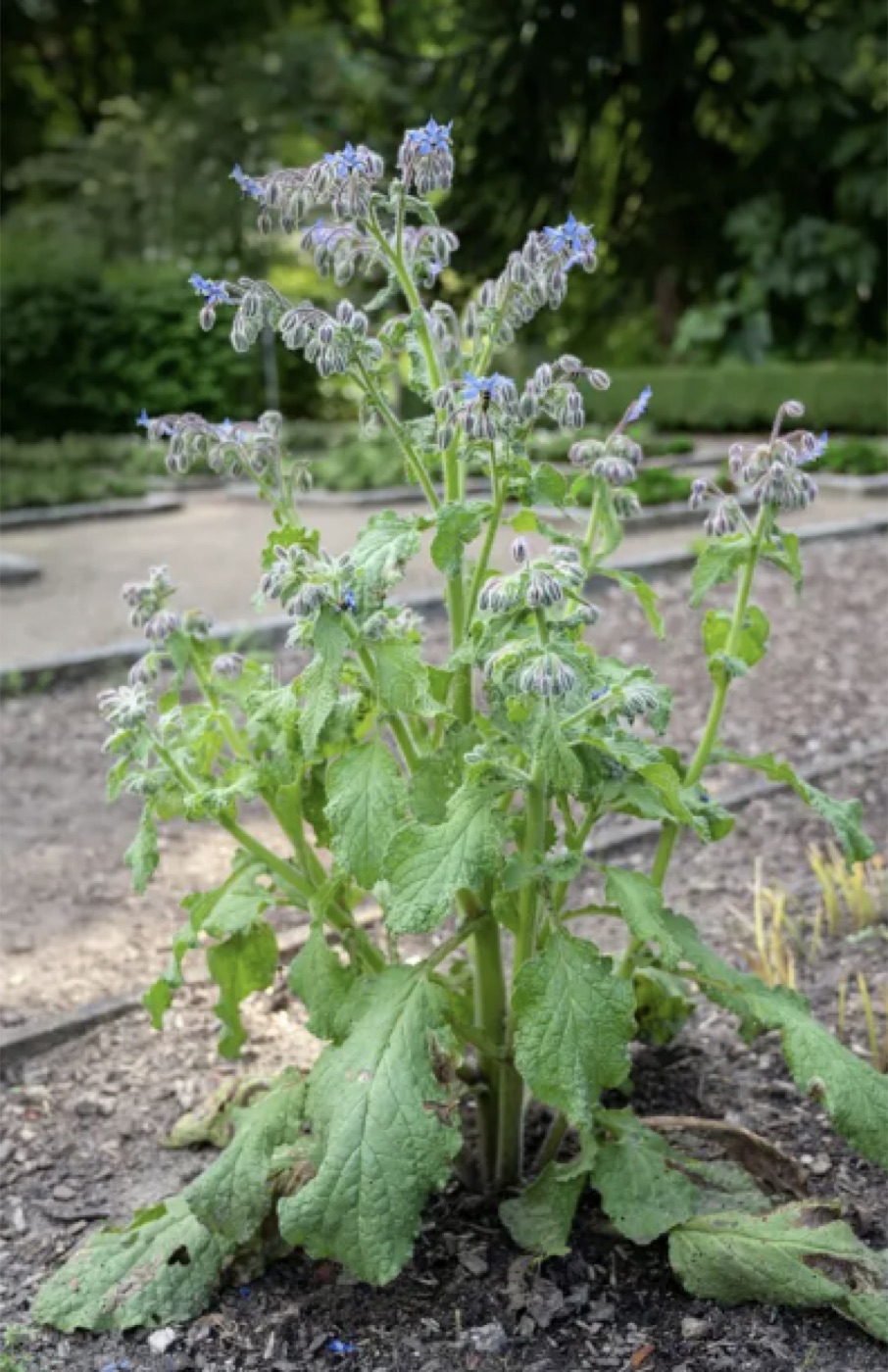
'Borago' may derive from the Arabic 'abu rash' (father of sweat), referencing its traditional use to induce perspiration as a fever remedy; or from the Latin 'borra' (rough hair or shaggy cloth), describing the plant's bristly covering. 'Officinalis' marks it as an official medicinal herb of the European pharmacopoeia. Borage has been cultivated since Roman times for food, medicine, and as a bee plant. It is an upright, bristly annual herb native to the Mediterranean, naturalised in disturbed coastal ground, roadsides, and garden margins throughout southern Australia. It is instantly recognisable by its extraordinary electric-blue, star-shaped flowers – among the purest blue of any plant – and its coarse, white-bristled stems and leaves. The flowers and young leaves are both edible, and it is an outstanding bee and pollinator plant.
When to Forage
Spring through early summer (September–January). Self-seeds prolifically and may return each year in the same spot.
Cautions
Contains pyrrolizidine alkaloids (PAs) in leaves, stems, and seeds – these compounds can be harmful to the liver in very large or prolonged quantities. The flowers contain negligible PAs and are considered safe for regular use. Use leaves occasionally and in small amounts, not as a bulk green. Do not use as a medicinal herb during pregnancy – pregnant people should avoid borage entirely. Borage seed oil supplements should not be taken without medical guidance. Culinary use of the flowers is well within safe limits.
Nutrition
Flowers: rich in vitamin C and potassium; contain flavonoids and anti-inflammatory compounds. Leaves: vitamin C, calcium, and potassium, with a refreshing cucumber flavour. Borage seed oil (not for foraging, but relevant) is one of the richest known plant sources of GLA (gamma-linolenic acid), an important fatty acid for skin and inflammatory conditions.
How to Identify
- Upright, branching annual, 30–70 cm tall. Covered throughout – stem, leaves, and calyx – in coarse, stiff white hairs (trichomes) that feel bristly to the touch.
- Leaves are large, oval to oblong, wrinkled, and very hairy; lower leaves long-stalked, upper leaves clasping the stem. Smell and taste distinctly of cucumber when crushed.
- Flowers are the unmistakable feature: five-pointed, vivid sky-blue to violet stars, with a cone of black anthers projecting from the centre. Occasionally white-flowered forms occur.
- Flowers droop in bud, then nod before opening fully – the nodding blue buds are a useful recognition feature.
- Fruit: four small black nutlets nestled in the persistent calyx.
Lookalikes
Also produces blue tubular flowers and is hairy. Distinguished by flowers that are narrowly tubular/funnel-shaped (not flat five-pointed stars), and red-tipped stamens protruding beyond the flower. Found in similar habitats. Avoid eating.
Very common purple-blue flowered weed in Australian pastures. Hairy, but flowers are trumpet-shaped, not star-shaped. Never eat.
How to Forage
Pick individual flowers by hand, pinching at the base of the star where it meets the green calyx – the calyx is hairy and tough and is discarded. Flowers are best used fresh on the day of picking. Young, small leaves can be used in salads or cooked, but use sparingly and not habitually. The flowers are the safest and most rewarding part to forage.
Recipe — Borage Flower Lemonade & Crystallised Flower Ice Cubes
Ingredients: a large handful fresh borage flowers (calyces removed); juice of 3 lemons; 2 tbsp maple syrup or agave nectar; 750 ml cold sparkling or still water; ice; optional mint leaves. Method: Stir lemon juice and maple syrup together until dissolved. Pour into a jug with sparkling water and ice. Float borage flowers on top – they will turn pink-purple in the acid of the lemon juice (a beautiful transformation). Serve immediately. To make flower ice cubes, place one borage flower in each compartment of an ice cube tray, cover with water, and freeze. The frozen flowers turn a vivid pink-magenta – striking in drinks. Inspo: scatter borage flowers over salads, cold soups, or desserts as an edible garnish.
Want more?
Join our newsletter for more recipes, foraging guides and upcoming events.